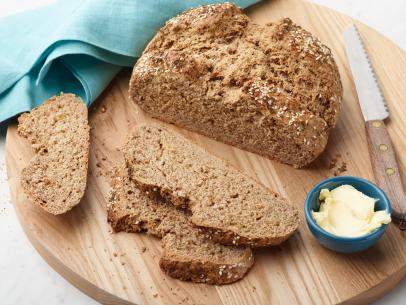

















Ballymaloe Brown Yeast Bread

Ballymaloe Cookery School

Show: Episode:

Rated 4 stars out of 5
  • Rate This Recipe
  • Read 5 Reviews
Total Time:
1 hr 15 min
Prep
15 min
Cook
1 hr 0 min
Yield:
1 loaf
Level:
Easy
x

Save To My Recipe Box

Please limit to 20 characters

Saving Recipe

Adding Recipe

Or Do Not Add

Success

This recipe was saved to your Folder_Name folder.

x

Save To My Recipe Box

Please sign in to save this recipe to your Recipe Box!!

25 Characters Max

Enter Time:

:
:

You can create up to five timers

Directions

When making Ballymaloe brown yeast bread, remember that yeast is a living organism. In order to grow, it requires warmth, moisture and nourishment. The yeast feeds on the sugar and produces bubbles of carbon dioxide which causes the bread to rise. Heat of over 122 degrees F/50 degrees C will kill yeast. Have the ingredients and equipment at blood heat. White or brown sugar, honey golden syrup, treacle or molasses may be used. Each will give a slightly different flavour to the bread. At Ballymaloe we use treacle. The dough rises more rapidly with 1 ounce (25 grams) yeast than with 3/4 ounce (20 grams) yeast.

We use a stone ground wholemeal. Different flours produce breads of different textures and flavour. The amount of natural moisture in the flour varies according to atmospheric conditions. The quantity of water should be altered accordingly. The dough should be just too wet to knead - in fact it does not require kneading. The main ingredients - wholemeal flour, treacle and yeast are highly nutritious.

Cook's Note: Dried yeast may be used instead of baker's yeast. Follow the same method but use only half the weight given for fresh yeast. Allow longer to rise. Fast acting yeast may also be used, follow the instructions on the packet.

Ingredients

  • 16 ounces/4 cups (450 grams) strong (stone-ground) wholemeal flour OR
  • 14 ounces/3 1/2 cups (400 grams) strong (stone-ground) wholemeal flour plus 2 ounces/1/2 cup (50 grams) strong white flour
  • 1 teaspoon salt
  • 1 teaspoon black treacle or molasses
  • 3/4 ounce to 1 ounce (20 grams to 25 grams) fresh non-GM yeast
  • 15 fluid ounces/ scant 2 cups (425 milliliters) water at blood heat plus 10 fluid ounces/1 1/4 cups (275 milliliters)
  • Sunflower oil
  • Sesame seeds, optional

Cook's Note: The ingredients should all be at room temperature.

Preheat the oven to 450 degrees F/230 degrees C/gas mark 8.

Mix the flour with the salt. In a small bowl or mixing cup, mix the treacle with 15 fluid ounces/ scant 2 cups (425 milliliters) water and crumble in the yeast.

Sit the bowl for a few minutes in a warm place to allow the yeast to start to work. Grease a 5 by 8-inch (13 by 20 centimeters) loaf tin with sunflower oil. Meanwhile, check to see if the yeast is rising. After about 4 or 5 minutes it will have a creamy and slightly frothy appearance on top.

When ready, stir and pour it, with all the remaining 10 fluid ounces/1 1/4 cups (275 milliliters) water into the flour to make a loose, wet dough. The mixture should be too wet to knead. Put the mixture into the greased tin. Sprinkle the top of the loaves with sesame seeds, if you like. Put the tin in a warm place somewhere close to the cooker or near a radiator perhaps. Cover the tins with a tea towel to prevent a skin from forming. Just as the bread comes to the top of the tin, remove the tea towel and pop the loaves in the oven for 20 minutes, then turn the oven down to 400 degrees F/200 degrees C/gas mark 6 for another 40 to 50 minutes, or until it looks nicely browned and sound hollow when tapped. The bread will rise a little further in the oven. This is called "oven spring". If, however, the bread rises to the top of the tin before it goes into the oven it will continue to rise and flow over the edges.

We usually remove the loaves from the tins about 10 minutes before the end of cooking and put them back into the oven to crisp all round, but if you like a softer crust there's no need to do this.

Print Recipe

Browse Reviews by Keywordnew!

Loading review filters...

COMMENT ON THIS PROJECT


Sign in

All fields are required.

E-mail Address:

Password:

Remember me on this computer

Signing in

Please enter your email address and we will send your password

E-mail Address

Your password has been sent and should arrive in your mailbox very soon.

Not a member?

Sign up for My Food Network to share photos, show off your style, and connect to an enthusiastic and helpful community.

It's free and easy.

Review This Recipe

You must be logged in to review this recipe.

Newest Ratings and Reviews

Read all 5 reviews

  • on March 22, 2013

    Flag

    I saw this bread on Bobby Flay's tour of Ireland. I thought it looked wonderful. I was right! I made it for the first time yesterday for my stamp club ladies and they simply devoured it. When I made it I started out using the weight measurement. DON'T make that mistake. Whoever converted the measurements doesn't know their ounces. So, I tossed it and went by the cup measurements and that was fine. The other thing is that they forgot to tell you when to add the oil. I know it said to use it to coat the pan, but obviously you need to add the rest to the recipe because it doesn't take 1 1/4 cups of oil to do that. So, I just added it when I added the water and yeast mixture to the flours. I used Stone Bur whole wheat flour and Better for Bread white flour. I will, next time, add a bit more salt and try more molasses, but I will definitely make this over and over again. It is such an easy and delicious yeast bread!

    people found this review Helpful.
    Was this review helpful to you? Yes | No
  • on July 18, 2011

    Flag

    This recipe produces the brown bread my Irish-born family likes best, although for variety I now tweak it. I add a tsp more each of salt and treacle and up to a tablespoon each of oat bran, oat germ, and pinhead oatmeal. I use the amount of water noted, but do bake somewhat longer. The determining factor in how well the bread turns out: the flour used. Over the years, I've tried all the US wholemeal flours I could find with varying degrees of success but finally decided to order online Odlums Wholemeal Extra Course. No comparison. Open the bag of Odlums and compare it to the US-flours and it looks and feels different. It is possible that the one negative review below is a result of the flour used. Remember: this recipe is from Ireland-- bakers use Irish flour. Check out the video--the only way the dough could pour like it does into the pan is if 3-1/4 cups of water is used. Maybe the reason that much water works is because the Irish flour soaks up more water?

    people found this review Helpful.
    Was this review helpful to you? Yes | No
  • on April 17, 2011

    Flag

    I researched all irish brown bread recipes that I could find and believe that there is an error in the amount of water. Use only 2 cups of water and you should have dough like what they describe here. I uses 2 teaspoon molasses with success. Everything else was the same. I decided on King Arthurs Irish-style wholemeal flour from their catalog. So now I started. The 2 cups of water turned out to be just fine as did the 2 teaspoons molasses. All in all it went together fast and very nice. After check for doneness it came out of the oven 10 minutes early and I did crisp the outside as shown in the recipe. When all is done, it make a very nice Irish brown bread. My husband loved it. Was very simple and fast to put together. I will make this again. We loved it.

    people found this review Helpful.
    Was this review helpful to you? Yes | No

Next Recipe

Advertisement

What's Hot

Iron Chef America

Hosted by: Alton Brown

Free Recipe of the Day Newsletter

Let Food Network chefs plan what's for dinner, with quick and easy recipes delivered to your inbox daily.

Ads by Google

© 2013 Television Food Network G.P. All rights reserved.