







How to Pull Off a Kamayan Feast at Home
The Filipino spread, typically made of an impressive array of barbecued dishes, is best enjoyed with your hands and good company.


Matt Armendariz
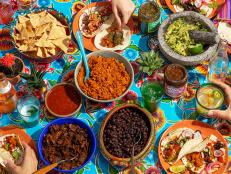
Imagine this: A sandy beach overlooking clear blue waters. On it, a colorful cabana has been set up with a spread of banana leaves underneath. Scattered across the leaves are an array of dishes. Crispy lechon kiwali. Tangy, garlicky chicken adobo. A mound of fragrant yellow-tinted fried rice.
That’s how chef and recipe developer Richmond Flores fondly recalls the kamayan feasts of his childhood. Meaning “by hand” in Tagalog, kamayan is a traditional Filipino form of eating that calls for laying food on top of banana leaves. Diners enjoy everything family style using their hands rather than utensils, the way it was done before the Spanish colonized the island nation.
“When I was growing up, whenever we’d visit the Philippines, we would usually have kamayan when we’d go to the beach,” says Flores. “There’s nothing around you. It’s really rustic and you’re just sitting there squatting and eating with your hands.”
Not every kamayan meal needs to be as picturesque. In fact, it’s the food and the company that Flores enjoys the most. Swap the beach for your dining room table or backyard patio. The beauty of hosting a kamayan is making it your own.

Matt Armendariz
“Whatever you like to cook, it could be part of a kamayan. You could do pulled pork, you could do a roast pig, you could do a whole vegetarian setup,” says Flores. “It doesn’t matter what the food is, it’s about pulling up your sleeves and sharing a meal with friends.”
But if you’d like to cook a meal with more traditional Filipino dishes, or need somewhere to start, we’ve put together 12 recipes, developed by Flores, that come together perfectly for a kamayan.
Here’s how to pull it all off.
Get the Recipes


Plan Your Menu
The first step in setting up a kamayan is, of course, filling out your menu. Our recipe collection features a variety of food that include meats, seafood, carbs, side dishes and sauces. There are richer, more decadent dishes like sticky glazed pork barbecue skewers and fried lechon kawali (pork belly) balanced with brighter, lighter ones like achara, a pickled green papaya relish, and a tangy, vinegar-based dipping sauce known as sawsawan.
Although your recipes don’t necessarily need to be Filipino, Flores does recommend this in keeping with the spirit of kamayan: “I, as many Filipinos I know, over prep. I think it’s more about abundance, being ready to surprise attendees. It’s more of a concern of not having enough. Everyone should have enough to indulge. Anything left over never goes to waste, and can go home with your guests.”

Matt Armendariz
Gather Your Tools
Cooking a kamayan meal doesn’t require a lot of special equipment. Most of the recipes that Flores developed for his menu use everyday cookware like a Dutch oven, saucepan or skillet. The one exception is a wok, which he uses to stir-fry the noodle dish, pancit bihon, and java rice. You can use a large frying pan in a pinch, but it’ll be harder to get the smoky, caramelized flavor that comes from tossing food in a wok.
You’ll also need a grill for the barbecued meats, plus some sturdy skewers. “I tend to choose a nice hefty bamboo skewer, like a double-thick one, just because it’s easier to eat off of,” says Flores.

Matt Armendariz
Banana leaves are another essential; frozen ones are the most readily available. “Everyone wonders if they have to be fresh,” says Flores. “If you have access to fresh, it’s great, but it’s really easy to get frozen at the Asian market. You can also order them online.”
Since kamayan feasts are enjoyed by hand, there’s no need to set out utensils, but be sure to have plenty of napkins.
What to Buy


Shop for Ingredients
With the exception of the Chinese sausage in the noodle dish, the proteins on Flores’ menu can be found at Western-style supermarkets. You’ll need several cuts of pork (belly, shoulder and butt), chicken thighs, shrimp and branzino. The same goes for much of the fresh produce and aromatics, such as the snow peas and cabbage in the pancit bihon, the Persian cucumbers and cherry tomatoes in the ensaladang pipino at kamatis and the red bell pepper and red onion in the achara.

Matt Armendariz
Your local Asian grocery store will likely carry everything else, like the Thai bird chiles that pop up in a few recipes and the condiments for the marinades and sauces. Flores says there’s no need to use strictly Filipino products if they’re difficult to find. “Your vinegar doesn’t have to be Filipino vinegar. Your soy doesn’t have to be Filipino soy. It’s nice if you want to keep the integrity of things, but at the same time, Filipino cuisine is a big mélange. It’s a lot of ethnicities, a lot of cultures that are kind of meshed together.”
Flores also includes swaps for certain harder-to-find ingredients. For example, the calamansi (a Filipino citrus) in the grilled shrimp marinade can be substituted with lemon or lime. You can also use a different type of noodle instead of the rice sticks in the pancit — in fact, Filipino cuisine has many variations, each named after the featured noodle (canton for egg noodles and palabok for cornstarch noodles).
But there is one thing that Flores advises against substituting and that’s the achara’s green papaya. “A lot of people think green papaya is just unripe papaya when it isn’t. When you get an unripe Florida papaya or Hawaiian papaya, it’s not the same as Thai green papaya. There’s a certain texture to it that allows it to hold better when you pickle it.”

Matt Armendariz
Prep for Success
According to Flores, most of the kamayan prep can be done in advance and is easy to break down into manageable chunks. “Filipino food is slow food. You could make it fast, but the joy of doing it is having time be the work. All these things take preparation. They’re not hard, but they do take time.”
Shopping can happen on separate days — you can grab all the dried goods at the Asian supermarket early in the week, then purchase the meat and produce later on. Like any good fried rice, the java rice requires day-old grains so be sure to get that step out of the way early. Condiments, such as the sarsa and sawsawan can also be mixed ahead of time and stored in the fridge.

Matt Armendariz
There’s also a good amount of protein prep to be done. Most of the meat and seafood can be sliced the day before and Flores has this helpful tip: “If you throw it in the freezer for 20 to 30 minutes prior to cutting it up, it makes it easier.”
Many of the proteins also require advanced marination, which allows the flavors to thoroughly work their way into the meat. This includes the Filipino pork barbecue skewers (Flores recommends five to six ounces of meat a stick) and pork tocino, which can stay in the fridge for up to two days. Reading through the recipes as you plan the menu will help you come up with a full list of which ones need a marinade. While that’s more prep work, it not only helps make the tastiest food, but also means that all you need to do is cook on the day of the party.

Matt Armendariz
If you purchased frozen banana leaves, don’t forget to thaw them. Flores also recommends cleaning them before you place on the food. “Wipe them down because they’re usually picked and packed, so there’s sometimes dirt all over them.”
When it comes to drinks, there are lots of alcoholic and non-alcoholic options that go nicely with the meal. “Filipinos love to drink beer. They love sweet drinks. This is basically a barbecue, so anything that you could have at a barbecue, you could have with your kamayan. Because Filipino food comes from a lot of ethnicities, it wouldn’t be surprising to see somebody serve sangria because there’s a lot of Spanish influence. It wouldn’t be surprising to have lychee iced tea because there’s a lot of East Asian influence.”

Matt Armendariz
Set up Your Kamayan Table
There are no hard and fast rules on how to assemble your kamayan spread. Spread out some newspapers, set down the clean banana leaves, then arrange the various dishes on top. Flores recommends dividing dishes across different areas of the table so everything is easily accessible to all the diners. “When I try to do it, I try to break it up into groups like pairs or threes, not more than three, because you don’t want people reaching over each other to grab things,” he says. “You kind of segment it on the table or the surface that you're making it on.” You can also separate foods to fit dietary preferences and place all the vegetarian dishes on one side, for example.

Matt Armendariz
Dig In — With Your Hands
Per tradition, a kamayan is enjoyed with your hands. After giving them a wash, you’re ready to dig in. The fingers of your dominant hand will act as your eating utensil, while your other can be used to grab napkins and drinks. To eat, simply “pinch your food between your three fingers and your thumb, and then you push it off your fingers with your thumb,” explains Flores.
Once dinner is done, cleanup is a breeze. “It’s just rolling up the banana leaves and newspaper that’s under it and throwing them away. You don’t have all the fuss of plates. Everything’s been divided equally amongst everyone in a sense and everyone’s able to enjoy and just dig in together, literally.”
Related Content: