

.jpg.rend.hgtvcom.126.196.suffix/1789013089131.jpeg)











4 Best Bread Machines of 2026, Tested and Reviewed
Make delicious homemade bread quickly and easily with an automatic bread maker.


Taylor Murray
The best bread machines will give you the ability to choose how dark you want the crust of your bread.
Tested by Taylor Murray
Whether you're looking to make homemade bread every week or want to whip up the occasional loaf of white bread, a bread machine can make the process a lot faster and easier. These machines may remind you of past generations' wedding registries, but they've seen a resurgence in recent years and come with many more bells and whistles. No matter what kind of bread maker you're looking for, we found the top bread machines for any kind of at-home baker.
Our Top Bread Machine Picks


Taylor Murray
Evaluating the crumb of the finished loaf.
How We Tested
We scoured the Internet to search for any bread machines that could pass our rigorous testing parameters. We scanned various online retailers for top sellers and favorites among users. Ultimately, we settled on 10 different models, all $300 or less, that were easily available to the average American consumer.
Before baking any actual bread, we read each manual cover to cover to see what kinds of information they included. The best manuals were full of great and unique recipes, as well as tons of information meant to help you be successful at baking bread, even if you've never made a loaf in your life. We looked at certain aspects such as size and construction. After all, if you're going to add another bulky appliance to your kitchen, it should have an efficient (and attractive) design. Using a decibel meter, we assessed how loud the machine was at its peak, which usually came during kneading. If any bread makers promised certain claims or special features, we checked to see if those features delivered. After baking the bread, we noted if the machines and their loaf pans were easy to clean.
After taking notes and making observations about the machine itself and its user interface, we got to baking. For the first test, we opted to make a plain white loaf of bread. By using the same recipe from a trusted source for each test, we were able to eliminate variations in results due to things like ingredients and recipes. Every loaf of bread was made with the exact same ingredients, at the exact same temperature and using the exact same recipe. Surprisingly, this did end up yielding wildly different results. After testing the plain white loaf, we chose a recipe from the included recipe book (if there were any). If there were any similarities or differences between this loaf and the white loaf, we noted them. We evaluated the recipe in terms of how easy it was to follow and finally, gave the bread a taste test. The best loaves had a nice open crumb and a tender, chewy texture that was firm enough to yield a sturdy slice.

- Compact
- Intuitive to use
- Useful manual
- Noisy
- Stainless steel housing can smudge
If you're looking for a sleek, compact bread maker that doesn't break the bank, the Cuisinart 2-Pound Bread Maker packs a lot of great features in a tidy package. It offers 12 pre-programmed settings, from classic white loaves to whole wheat and even gluten-free options. The machine also includes customizable crust settings, a delay-start timer and an easy-to-read LCD display. Plus, the included recipe book is filled with innovative and well-tested recipes that are clear and easy to follow to give aspiring bakers plenty of inspiration.
During our testing, the Cuisinart consistently produced better-than-average loaves with excellent texture and even browning. The machine's intuitive design made setup and operation straightforward, while the kneading and baking process was impressively quiet. The loaves had a pleasant rise, a nicely developed crust, and a soft, airy interior that rivaled store-bought bread. We also appreciated how easy it was to clean, with a nonstick bread pan that made removing finished loaves effortless. For anyone curious about bread making, this model offers an accessible price point and reliable performance, making it a great choice for fresh, homemade bread with minimal effort.
- Weight 10 pounds
- Material Stainless steel and plastic
- Capacity 2-pound loaf
- Settings 12 settings including white, wheat, sweet, gluten-free, dough and jam
- Number of kneading paddles 1
- Helpful manual with recipes
- Illuminated LCD display
- Large capacity
- Automatic add-in dispenser
- Expensive
- Collapsible paddles can jam
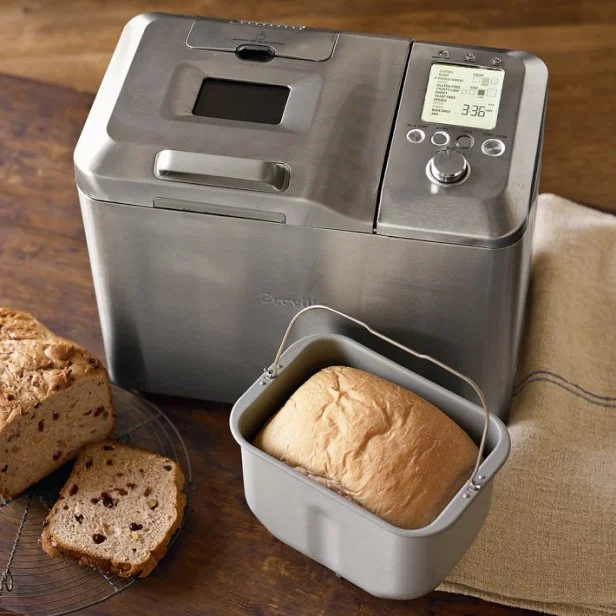
The Breville Custom Loaf Bread Maker is a top-tier choice for anyone serious about home bread baking. It comes with an ultra-thick manual packed with unique and mouthwatering recipes, from crusty olive and roasted garlic bread to honey whole wheat cinnamon raisin. It even includes a recipe for tangy sourdough, a rare find in bread maker manuals. The machine's bright, easy-to-read LCD display and intuitive controls make the baking process simple, even for beginners. Despite its ability to produce loaves up to two and a half pounds, the Breville has a surprisingly compact footprint, taking up less counter space than some smaller-capacity models. Unlike most other bread machines, the Breville has a unique collapsible paddle which can minimize the hole left in the bottom of the bread characteristic of other machine-made loaves. With a sleek chrome body that looks stylish enough to leave out full-time, it's as much a design statement as it is a functional appliance.
During our testing, the Breville performed flawlessly, producing consistently high-quality loaves with impressive crust development, airy interiors and a perfect rise. Each test loaf emerged with the kind of artisan texture and flavor you'd expect from a high-end bakery, rather than a machine. The dough-kneading function was particularly well-calibrated, creating a smooth, well-developed dough every time. Whether it was a simple sandwich loaf or a more complex multigrain bread, this machine handled it all with ease. The build quality felt solid, and cleaning was a breeze thanks to the nonstick pan. If you're looking for a high-performance bread maker that delivers professional-quality results, the Breville is well worth the investment.
- Weight 16 pounds
- Material Stainless steel
- Capacity 2 1/2-pound loaf
- Settings 13 settings, including whole wheat, gluten-free, pizza dough, pasta dough and jam
- Number of kneading paddles 2
- Bread pan shape Rectangular

- Affordable
- Easy to use
- Lightweight
- Not dishwasher-safe
- Minimal special features
- Noisy
This bread machine has the exact same design (I'm talking identical) to the CRUXGG model we tested but is $100 cheaper. The Amazon Basics Bread Machine doesn't have a lot of extra features, but it comes at a great price and can perfectly make a delicious loaf of fresh bread. The manual includes a small but useful collection of straightforward recipes that are easy to follow, making this machine an excellent choice for beginners or those who prefer a no-fuss approach to bread making. Plus, its lightweight design makes it easy to move and store, a bonus for those with limited counter space.
This model has the exact same loaf pan design as the (more expensive) Oster and Cuisinart units we tested but yielded a similar or better loaf of plain white bread. We were pleasantly surprised by the open crumb (and not at all crumbly) texture of the simple white loaf made in this machine, indicating that the paddles were strong enough to develop sufficient gluten structure. We did note that the top of the bread caved in slightly during baking, but this did not affect the interior of the bread and we still ended up with nice, firm slices perfect for sandwiches.
- Weight 7.39 pounds
- Material Plastic
- Capacity 2-pound loaf
- Settings 14 settings including basic white, gluten-free, French, sweet, yogurt, dough, cake and jam
- Number of kneading paddles 1
- Bread pan shape Square

- Makes large loaves
- Easy to clean
- Finished loaves look handmade
- Bulky
- Not dishwasher-safe
For super-big loaves, there is no equal to the West Bend. This machine can make a whopping three-pound loaf, as well as smaller loaves, without breaking a sweat. This machine (unlike many other similar models) has a custom-shaped loaf pan that mimics a standard bread loaf pan. While other bread machines bake the bread in an upright tube, the West Bend bakes the bread horizontally, delivering picture-perfect slices. It has two kneading paddles for optimum mixing and 12 customizable settings that range from whole wheat to French. The large capacity of this model does come at the cost of counter space, so consider that when choosing the right machine for you.
The loaves we tested in this machine were similar in look, texture and quality to even artisanal hand-baked loaves. Our first loaf in the machine was a simple white bread, which developed a deep golden brown crust and a fluffy, open crumb inside. Unlike many other machines, the loaves from this model did not cave in on top at all, even on the softer, sweet oatmeal maple loaf we made in the West Bend.
- Weight 15 pounds
- Material Plastic
- Capacity 3-pound loaf
- Settings 12 settings including basic, whole wheat, sandwich, dough, sweet, super rapid and custom
- Number of kneading paddles 2
- Bread pan shape Rectangular
What to Look For When Buying a Bread Machine
With thousands of bread machines on the market, it can be hard to know where to start or what to look for. There are a few key features that come standard in even the most budget-friendly options we tested. Ultimately, the machine you choose will depend on your baking ability, budget, and aspirations.
It should be able to make standard white bread.
First, any top bread machine should be able to make a decent loaf of standard white bread from start to finish, including kneading, proofing and baking. Most models come with a 13-hour delay start timer, which is perfect for setting before work or before bed.
Look for a range of functions.
Any good bread machine will come with a range of functions, including standard white bread, whole wheat, sweet and gluten-free, as well as several individual settings, such as knead or bake.
Adjustable sizes can be helpful.
You should look for a machine that lets you adjust the size of your loaf from several options, as well as a crust darkness setting. This will ensure the most success in your baking.
Opt for machines with a nonstick loaf pan.
Every machine we tested comes standard with a nonstick-coated loaf pan for easy clean-up.
You might want some special features.
Finally, some models come with special features such as a viewing window (to observe the bread without opening the machine) and a special chamber that can automatically release mix-ins such as dried fruit and nuts at the correct stage.

Taylor Murray
A more open crumb in the white bread loaf.
Frequently Asked Questions
Can a bread machine make bread start-to-finish?
Yes. The best bread machines are designed to make simple breads like a white sandwich loaf completely on their own. All you need to do is dump the ingredients in.
Is making bread in a bread machine cheaper than buying it?
It depends on your household. If you go through multiple loaves of bread each week and are looking for ways to DIY it or save on more artisan-style bread, a bread machine could help your budget. However, if you only use bread a few times a month, it might not be the best investment.
Can you make sourdough in a bread machine?
Yes, most bread machines can handle a sourdough loaf, however, it might not be as crusty as loaves baked in a Dutch oven in the oven.
Do you need special ingredients for a bread machine?
Nope! These machines are designed to be used with good old all-purpose flour and standard instant yeast or active dry yeast. Some recipes may call for special flour or yeast, but that's recipe specific.
How do you clean a bread machine?
One of the great things about investing in a bread machine is the sheer ease of use, including quick cleanup. Every step, from raw ingredients to finished product is contained in the loaf pan. Almost all bread machines (and every model we tested) come with a nonstick finish that makes cleaning up after a breeze. For most loaves, a quick wipe with a damp cloth should be sufficient to remove any residue. If some stubborn stuff remains, try scrubbing with a soft-bristled brush. Anything rougher could damage the nonstick coating. For the exterior, just wipe with a soft cloth.
Why You Should Trust Our Tester
Taylor Murray is a graduate of Johnson and Wales University with a degree in Culinary Nutrition. She worked as a professional chef for over 10 years before moving into recipe and product testing and development. She has tested several hundred products for Food Network and other brands over the last six years, covering everything from carbon-steel pans to food dehydrators.
Why You Should Trust Food Network Shopping Experts
Food Network Shopping Experts believe the best method for testing products is based on how our fans are going to use them in the real world. In each of our Tested and Reviewed stories, products are tested in real home kitchens that reflect real-world use cases. Our testers follow rigorous testing rubrics designed by our expert editors and take copious notes during the testing process. When choosing the best products, our testers evaluate all of the testing data and take into consideration many factors including ease of use, price, product availability and practicality. The products covered on FoodNetwork.com are chosen completely independently by our editors without any outside influence. Our editors do not accept products in exchange for a positive review or promised coverage.
Related Links: