

.jpg.rend.hgtvcom.126.196.suffix/1789013089131.jpeg)











Smoked Whole Turkey
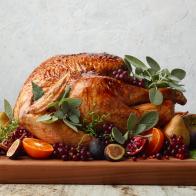
For a tender, juicy twist on the classic roast bird, give our best smoked turkey recipe a try.


- Nutritional Analysis
- Per Serving
- Serving Size
- 1 of 10 servings
- Calories
- 757
- Total Fat
- 35 g
- Saturated Fat
- 12 g
- Carbohydrates
- 12 g
- Dietary Fiber
- 3 g
- Sugar
- 3 g
- Protein
- 94 g
- Cholesterol
- 329 mg
- Sodium
- 1667 mg
Article by Emily Saladino
Once you learn how to smoke a turkey, you might never go back to a traditional roast bird. With these tips from Food Network Kitchen, the mostly hands-off cooking method produces perfectly tender, flavorful meat that stands up to creamy mashed potatoes, savory gravy, and other Thanksgiving or holiday foods. Here’s everything you need to know.
How to Smoke a Turkey Like a Pro
The Food Network Kitchen team tested several approaches to determine the best way to smoke a turkey so it turns out rich and juicy.
Pat the turkey dry. Before you start cooking, dry the entire exterior of the bird with paper towels. A dry surface helps the turkey dry rub adhere so it can tenderize the meat and infuse every bite with flavor.
Set the smoker temperature for smoked turkey. Our recipe developers suggest setting the turkey smoker to 350 degrees F so the meat cooks evenly and relatively quickly while staying moist.
Experiment with different herbs. Stuffing the turkey cavity with aromatics like onions, garlic, and herbs infuses the meat with flavor and moisture. Try parsley, thyme, rosemary, sage, or a mixture.
Don’t baste right away. Smoking the bird for an hour before you baste it helps crisp up the skin. Plus, as the turkey cooks, it drips flavorful juices into the roasting pan. Those drippings make the basting liquid even richer and more savory.
How often to baste a smoked turkey. After the turkey has been in the smoker for an hour, start basting it every 30 minutes. It flavors the meat and locks in moisture.
How long to smoke a turkey. Our recipe developers find that smoking a 12- to 14-pound turkey at 350 degrees F for approximately three hours produces a tender, juicy bird.
Take your smoked turkey’s internal temperature. After about two hours of basting, insert an instant read thermometer in the turkey’s thigh. The Food Network Kitchen team finds that the best internal temp for smoked turkey is 165 degrees F.
Best Wood to Smoke a Turkey
The best turkey smoking wood is a medium hardwood like maple, pecan, or cherry, according to the Food Network Kitchen team. “You want to impart a lot of flavor but you don’t want to overpower the turkey’s delicate meat,” says Amanda Neal, lead recipe developer at Food Network. “Something like venison or beef can take a richer wood, but poultry should use a mild or medium hardwood.”
The best wood to smoke a turkey include:
Maple: Maple wood adds earthy, herbaceous flavors to smoked turkey, Neal says, “and it’s great when paired with a rub that’s already laced with strong herbal flavors.” It gives smoker turkey a golden brown hue, too.
Pecan: Like maple, pecan wood imparts a burnished, golden brown color. “I love pecan’s ability to provide a balance of sweetness, smokiness, and nuttiness to the meat,” Neal says.
Cherry: Cherry provides sweeter undertones that would pair well with the flavors of a Thanksgiving spread. Plus, “this wood will provide a beautiful red hue to the bird,” Neal says.
Should I Brine My Turkey Before Smoking? And Other Flavor Tips
The Food Network Kitchen team uses a dry rub to build flavor fast—no overnight soaking required. Our recipe developers find that the best turkey rub has earthy flavors like paprika, garlic, and onion powder, plus salt and brown sugar to tenderize and season the meat. This smoked turkey rub produces enough flavor to complement the mildness of the meat without overpowering other holiday favorites on the table.
You can customize your smoked turkey dry rub by amping up the cayenne for more heat, swapping the thyme for dried rosemary or parsley, or using white pepper instead of black.
Brining a smoked turkey is another way to add flavor and keep the bird from drying out. For ideas, check out our basic brined smoked turkey recipe; or, see Damaris Philips’ recipe for a brine for turkey in the smoker made with Worcestershire, molasses, sugar, garlic, and bay leaves.
Smoked Whole Turkey
- Level: Easy
- Total: 3 hr 30 min
- Active: 15 min
- Yield: 8 to 10 servings
-
- Nutritional Analysis
- Per Serving
- Serving Size
- 1 of 10 servings
- Calories
- 757
- Total Fat
- 35 g
- Saturated Fat
- 12 g
- Carbohydrates
- 12 g
- Dietary Fiber
- 3 g
- Sugar
- 3 g
- Protein
- 94 g
- Cholesterol
- 329 mg
- Sodium
- 1667 mg
- Level: Easy
- Total: 3 hr 30 min
- Active: 15 min
- Yield: 8 to 10 servings
-
- Nutritional Analysis
- Per Serving
- Serving Size
- 1 of 10 servings
- Calories
- 757
- Total Fat
- 35 g
- Saturated Fat
- 12 g
- Carbohydrates
- 12 g
- Dietary Fiber
- 3 g
- Sugar
- 3 g
- Protein
- 94 g
- Cholesterol
- 329 mg
- Sodium
- 1667 mg
Ingredients
Directions
Special equipment:
a smoker; a turkey baster- Preheat a smoker to 350 degrees F.
- Remove any turkey parts from the neck and breast cavities and reserve them for other uses if desired. Pat the turkey dry with paper towels, inside and out.
- Combine the salt, paprika, brown sugar, black pepper, garlic powder, onion powder, dried thyme, dried sage and cayenne together in a medium bowl and mix to combine. Sprinkle the turkey all over, including in the breast cavity, with the spice mixture. Stuff the cavity with the onion, garlic, fresh herbs and bay leaves. Set the bird breast-side up on a roasting rack set in a roasting pan. Pour the broth into the bottom of the pan and add the butter.
- Transfer the roasting pan to the smoker and cover with the lid. Smoke until the skin is slightly golden, about 1 hour.
- Baste the turkey with the broth in the pan. Continue smoking the turkey, basting it with broth every 30 minutes, until an instant-read thermometer inserted in the thigh registers 165 degrees F, about 2 hours more.
- Remove the turkey from the smoker and set aside to rest for 15 minutes. Carve and serve.


